Design your ships. Research alien tech.
Send your fleet into the stars.
Alien Shards are compressed possibility. The same crystal yields different results to different researchers. Your tech catalog is uniquely yours - no two players discover the same arsenal.
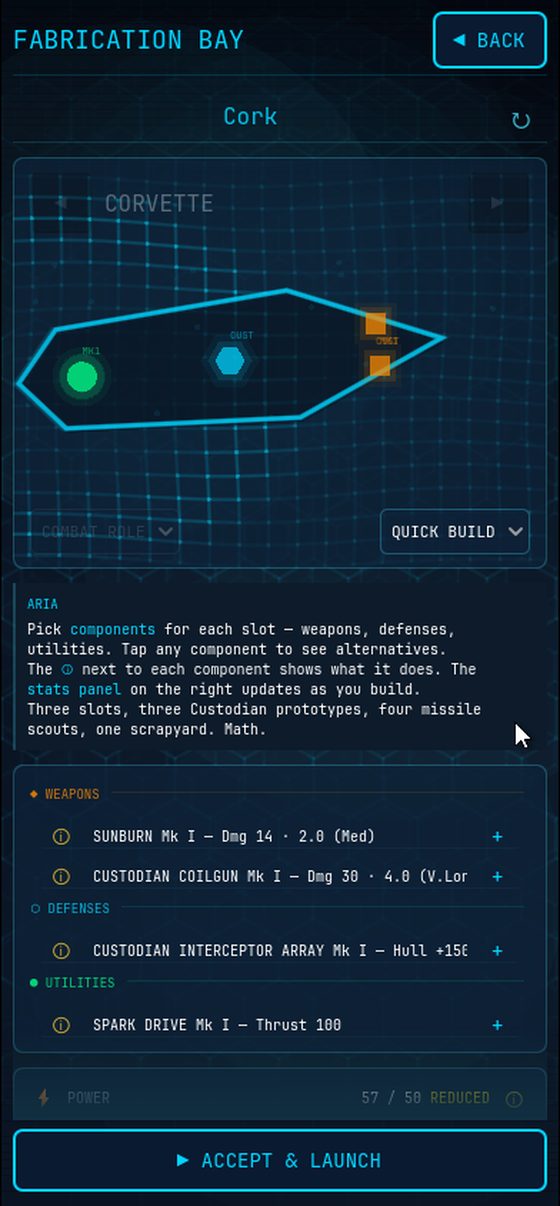
Ship design isn't picking from a menu. It's engineering - power budgets, mass limits, component slots, trade-offs that matter. Every ship you field is something you built.
Your fleet fights autonomously in cinematic battles with BSG-style camera work. No reflexes. No micro. You made the decisions before the first shot - now watch them play out.
After every battle, ARIA breaks down what happened - accuracy, damage, timing. The Custodians profile your fleet and build specific counters. Last battle's winning strategy is next battle's known weakness.
60 missions, each a self-contained design challenge. Not a grind - a puzzle. The right tech, the right ship, the right fleet. Losing teaches you something. Winning proves you learned it.
Your AI companion masks existential dread with statistical analysis. She doesn't lecture - she diagnoses. "Your budget went two directions. Your fleet went zero."
I'm an engineer. I love sci-fi. I love turn-based and real-time strategy - the kind where you think, not twitch.
Over twenty years ago I started working on a game called Genesis - a phase-based tactical simulation set in space.
You are the admiral and the chief engineer. You research technology that evolves differently for every player. You design ships from components. You compose battle groups, set their doctrine, manage supply lines, and send them across a galaxy-spanning jump lane network. Then you watch - or command - as your creations clash among the stars.
I was young, naive, and - as it turns out - an engineer with an engineer's sense of timelines.
I even had working code. This was the state of the art.
A thriving community of two friends who helped me out.
It only needed some farther development.
But then life happened instead. Career. Kids. Mortgage. The project went into a drawer. The drawer stayed shut for twenty years.
A few months ago, I decided to show my kids how fun and easy it is to code. I was wrong. It wasn't easy. It wasn't fun. But 352 commits later - here we are.
Star Forge is one piece of Genesis - just the ship design and tech research loop. A game that makes you think like an engineer. Build a fleet, send it out, watch it go boom. Or not. Adjust. Try again. You start as a junior tech and work your way up to grand architect - and failing isn't losing. It's the moment right before you figure it out.
The weapons are better than stones now. Mostly.
Star Forge - Ship design and tech research
Containment Protocol - Fleet tactics and doctrine
Mobile release - All systems combined
The complete Genesis experience
Autonomous Research Intelligence, Ariel-class. Station AI. Three years alone on a deep-space research station. She masks existential dread with bureaucratic precision and statistical analysis. She's the player's companion, critic, and reluctant ally.
Sixty years ago, a survey drone found a gate orbiting Sedna. When Dr. Lena Vasquez activated it with a microwave pulse - later described in her memoir as "I basically honked at it" - it connected to another gate, 40 light-years away. Then another. Then sixty more.
The Lattice - a galaxy-spanning network of jump lanes - had been waiting. At each node: ruins. Empty stations. And sealed containers of crystalline material that rearranged itself when studied.
Humanity called them Shards. They weren't technology. They were compressed possibility. The same Shard could yield a railgun or a regenerative hull coating, depending on who studied it.
Nobody built the Lattice for humanity. But someone built it. And now the builders' automated systems - the Custodians - are waking up. They're not evil. They're procedural. And they are taking notes.
No spam. Just launch day + major milestones. Unsubscribe anytime.
Also my wife thinks I'm "showing the kids how to code." Every signup helps me justify the hours.